Swimming in the Lake

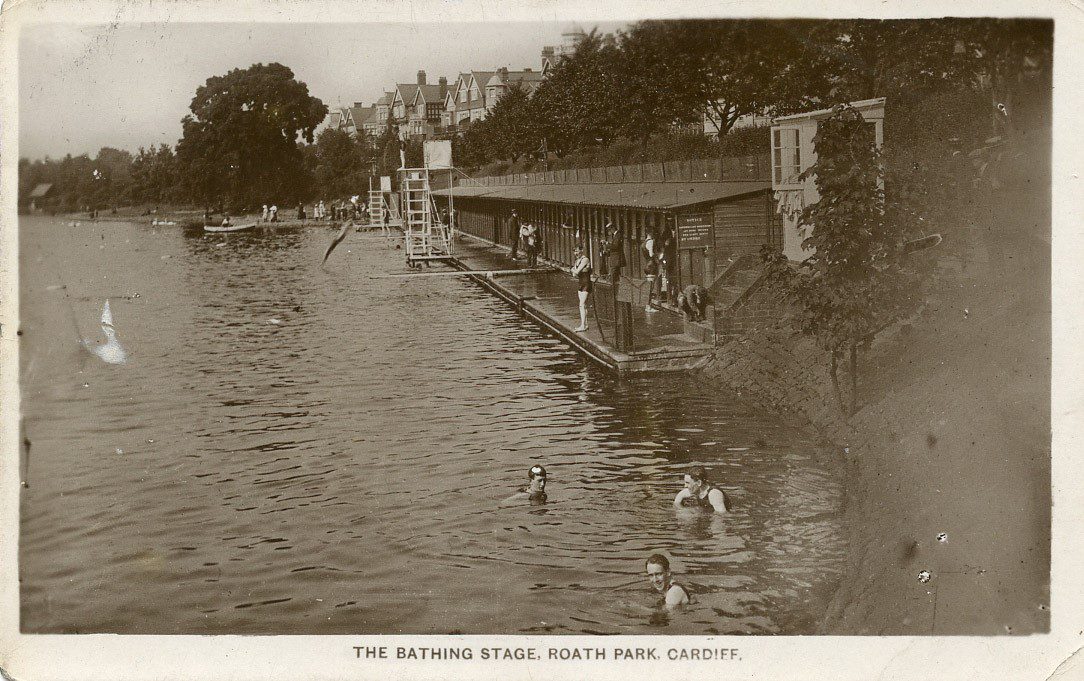
Swimming in Roath Park Lake was once a very popular activity enjoyed by hundreds of Cardiff residents every week during summer. In 1898, the Council employed a ‘swimming expert’ who was paid 26 shillings per week to supervise swimmers in the lake. Later, this role changed to ‘Life Saving Attendant’, the equivalent of a modern-day lifeguard.

The bathing stage was built in 1900 and a diving board installed for swimmers to enjoy.

Although so many people swam in the lake, there were no changing rooms or places to leave clothes. In 1901 it was reported that swimmers getting changed were causing offence to passing cyclists. After much discussion, 100 Laurel shrubs were bought to plant as a screen for the bathing stage in 1905.

In the summer of 1907, there were often over 500 swimmers per day. Swimming was allowed from 6am until 9am every day, and people were required to wear ‘proper bathing dresses’. In 1908, 63 ‘dressing boxes’ were built, which swimmers could use for a fee of 1 old penny.

The continued popularity of swimming in the lake led to the need for rules and regulations for swimming, and bathing costumes being provided for hire. Evening swimming was also introduced in 1909. People came from all over the city to swim, and there would be numerous rows of bikes lined up along the footpaths.

It wasn’t until June 1911 that mixed swimming was allowed in the lake. Men were not allowed to land on the area of the bathing stage in front of the women’s dressing boxes and vice versa. In the especially warm summer of 1911, the Parks Superintendent W. W. Pettigrew reported that more than 44,000 swimmers had gone through the turnstiles at the bathing stage. In the following years, the numbers of swimmers kept increasing, although this varied hugely depending on the weather.
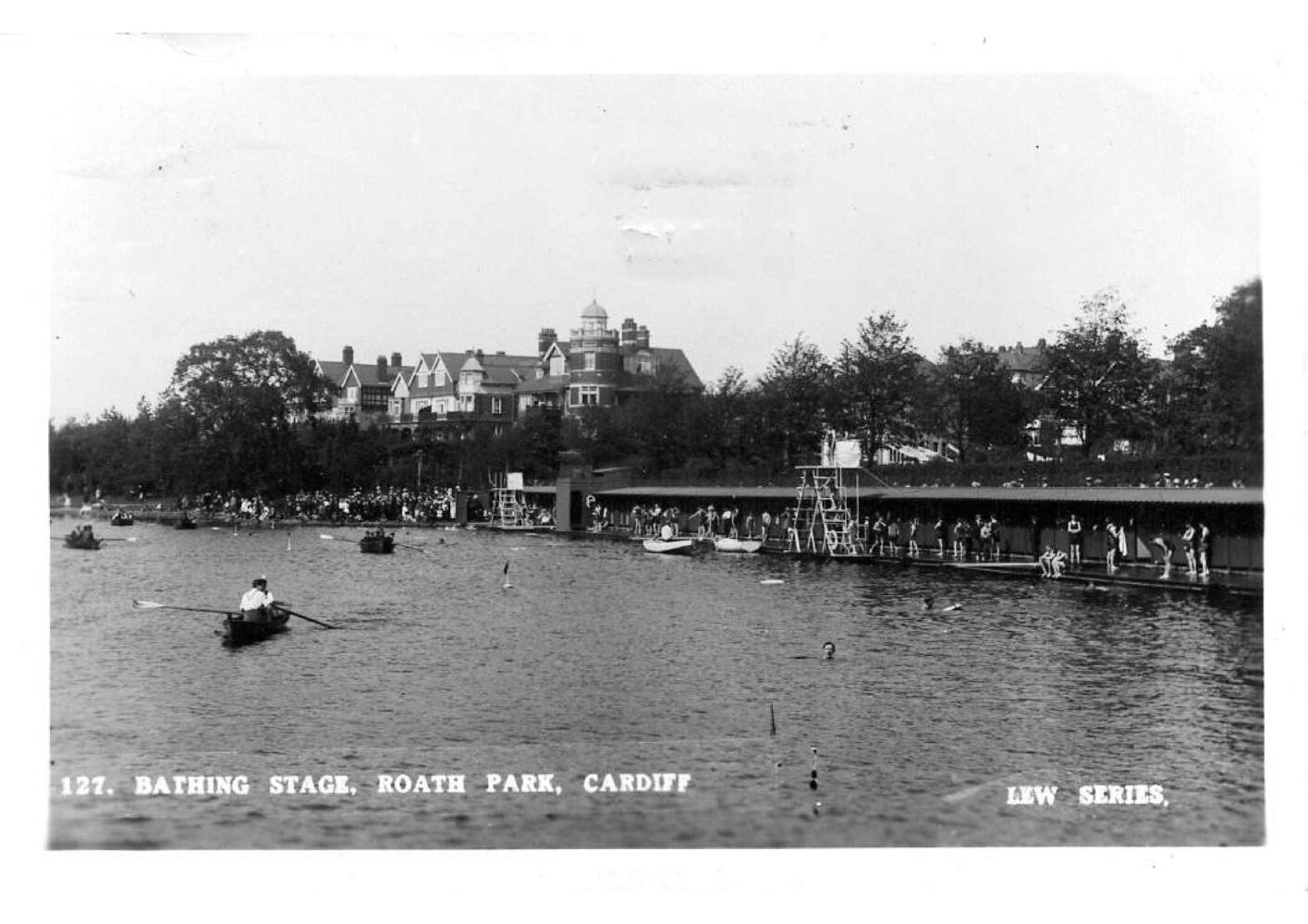
black and white historic photo of the bathing stage at Roath lake
Bathing Stage, Postmarked 1926 (Barry Library, used under Creative Archive Licence)

By 1920, swimmers would pay 2 pence each for access to the bathing stage, plus the hire of a swimming costume and a towel. The women’s dressing boxes were extended in 1924, and seating was created for those who wanted to watch the swimming.

Water quality problems

An infestation of parasites in the water caused an outbreak of skin irritation among swimmers during the summer of 1928. A weak solution of copper sulphate was used to get rid of the parasites in the lake without harming other wildlife and plants. This was a success and swimming was once again popular by the end of the 1930 season.

Unfortunately, the lake had to be closed again in 1947 and treated with copper sulphate for the same parasite problem. It was reopened for swimming, but it wasn’t long before problems with the water quality again meant closing it in 1949. After that, swimming was not allowed, apart from private events such as the Taff Swim. It was suggested that a portion of the lake could possibly be made into a swimming pool with chlorine in the water, but it was decided that a purpose built swimming pool would be a better option.

Although the lake was dredged and cleaned, the water was tested again in 1953 and experts judged that it wasn’t safe for public swimming. Following major work, weed cutting and more treatment with copper sulphate, the lake opened for swimming again in July 1957. Further work was done to improve the movement of water in the lake, with the building of a weir and a discharge channel. Despite all of this work, repeated testing proved the water quality didn’t meet the standard for swimming and it was decided that the lake wouldn’t reopen at the start of the 1959 season.

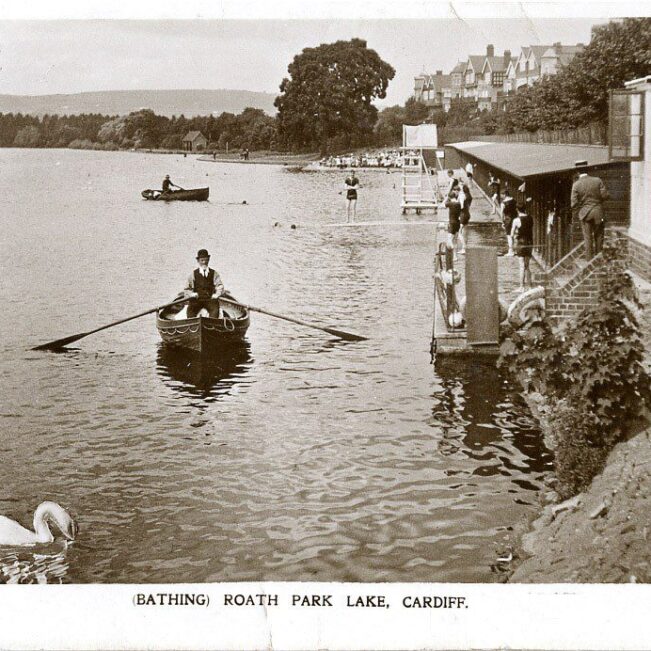
historic postcard showing bathing huts on Roath Lake with swimmers getting ready and a rowing boat passing by
Bathing huts, post marked 1912 (The Royal Photographic Company London (cardiffparks.org.uk)

Irene Steer

Irene Steer was the first Welsh woman to win a Gold Medal at the Olympics. She struck gold in 1912 at the Stockholm Olympics where she was the anchor leg swimmer in the world record breaking British 4 X 100 yards freestyle relay team.

Irene learned to swim in Guildford Crescent Baths in the City Centre and practised in Roath Park Lake.

She became the first Welsh swimmer to be awarded a Welsh Swimming  Association certificate for breaking 100 seconds for 100 yards in 1907. She won the Welsh 100 yards title for 7 years in a row from 1907 until she retired in 1913.

Irene Steer was a sporting pioneer. When she competed at the 1912 Olympics, it was the first time women had been allowed to enter the swimming competitions. It would be 96 years before another Welsh woman struck gold at the Olympics, when Nicole Cooke won the women’s cycling road race in Beijing in 2008.

historic photo showing bathing huts at Roath Park lake with swimmers
W.H.S.S. The Grosvenor Series (cardiffparks.org.uk)

Friends of Roath Park Logo
Working in partnership with Friends of Roath Park

Website designed by Cardiff Council Web Team

Cookie policyPrivacy policyAccessibility statement